Philosophy
What is Cinematic Learning?
Imagination
Narrative
Cinematic Language
Learning becomes more meaningful when ideas are experienced imaginatively. Cinematic Learning uses imagery, atmosphere, metaphor and emotion to give abstract concepts a form students can explore.
Stories provide more than engagement. Narrative can give learning structure, allowing students to encounter concepts through characters, conflicts, choices and changing perspectives.
Film can shape how students experience an idea. Framing, sound, colour, pacing and visual symbolism can create emotional and conceptual connections that conventional instructional materials may not.
From Story to Inquiry
Cinematic Learning uses narrative as a starting point for inquiry. Students encounter ideas through story, character and visual experience before exploring the concepts, questions and connections that emerge from them.

Encounter the Story
Students enter a carefully constructed narrative world through character, atmosphere, conflict and cinematic imagery.
Experience

Explore the Tension
Questions, contrasts and conceptual tensions within the story become starting points for discussion, investigation and inquiry.
Inquiry

Build Understanding
Students connect the narrative experience to concepts, knowledge and their own perspectives, developing increasingly complex interpretations.
Connection
The Foundations of Cinematic Learning
Cinematic Learning is an emerging approach to inquiry that brings together imagination, narrative and cinematic language. It draws on established ideas about how stories shape meaning, how imagination supports understanding, and how inquiry allows learners to construct connections for themselves.
Imagination
Kieran Egan argued that imagination is fundamental to learning. Story, metaphor, mystery, binary opposites and emotional meaning can make knowledge more memorable and meaningful, allowing learners to engage with ideas beyond the purely factual.
Narrative
Jerome Bruner argued that narrative is a fundamental way of making sense of experience, helping learners organise events, intentions and perspectives into meaningful structures. Dorothy Heathcote's Mantle of the Expert demonstrated how narrative can go further: an imagined context can become a setting for purposeful learning, where students investigate problems, apply knowledge and construct understanding from within the story.
Inquiry
Kath Murdoch describes inquiry as a process in which learners actively construct understanding through questioning, investigation, connection and reflection. Rather than simply receiving knowledge, students explore ideas, follow emerging questions and develop meaning through experience and dialogue.
Joseph Campbell's comparative work on myth, later adapted for storytelling by Christopher Vogler, described a recurring journey of departure, challenge, transformation and return. The Hero's Journey has since been explored in educational contexts as a framework for learning and reflection. Simpson and Coombes examined its use for critical self-reflection and self-awareness, while more recent research by McKay and colleagues explored its relationship with reflection, identity and professional learning. Cinematic Learning draws on this wider tradition as a metacognitive framework through which learners can locate, interpret and reflect upon their own learning journey.
Hero's Journey & Metacognition
Cinematic Learning extends these foundations through ideas drawn from film theory and cinematic practice. Framing, perspective, sound, colour, pacing, symbolism and atmosphere shape how learners encounter and interpret ideas.
Emerging generative technologies expand the possibilities for teacher authorship, making it increasingly possible for educators to create purpose-built cinematic experiences around the concepts and learners they teach.
Film Theory & Teacher Authorship
The Cinematic Learning Framework
Cinematic Learning brings together a recurring process of experience, interpretation and inquiry. Narrative and cinematic language create imaginative encounters; learners explore the tensions, questions and concepts that emerge, developing and communicating their own understanding while continually revisiting the experience.

Curriculum Integration Model
Cinematic Learning does not replace an existing curriculum framework. Purpose-built cinematic narrative provides an imaginative spine through which concepts and questions are encountered, while inquiry develops understanding and the Hero's Journey provides one possible language through which learners can reflect upon their developing learning.

Cinematic Learning in Practice
Inquiry
Narrative
Reflection




The Fog becomes both a science investigation and a metaphor for fear vs understanding, helping students to explore uncertainty, perception and migration. From there they research historical examples of migration and write fictional memoirs from the past.


Where We Are in Place & Time follows a young girl on a journey shaped by migration, memory and belonging. Created specifically around the unit’s conceptual focus, the film provides a continuing narrative world through which students encounter questions about why people move, how places change, and how migration shapes individuals and communities.
Students move from the narrative into active inquiry, investigating the questions and tensions that emerge from the story. Through research, discussion, and experimentation, they gather evidence, test ideas and make connections across concepts and disciplines. The film provides the imaginative starting point; inquiry allows students to construct their own understanding.
Students map their learning onto the Hero’s Journey, identifying moments of challenge, support, discovery and change to make their thinking and growth visible.


Narrative
Inquiry
Reflection


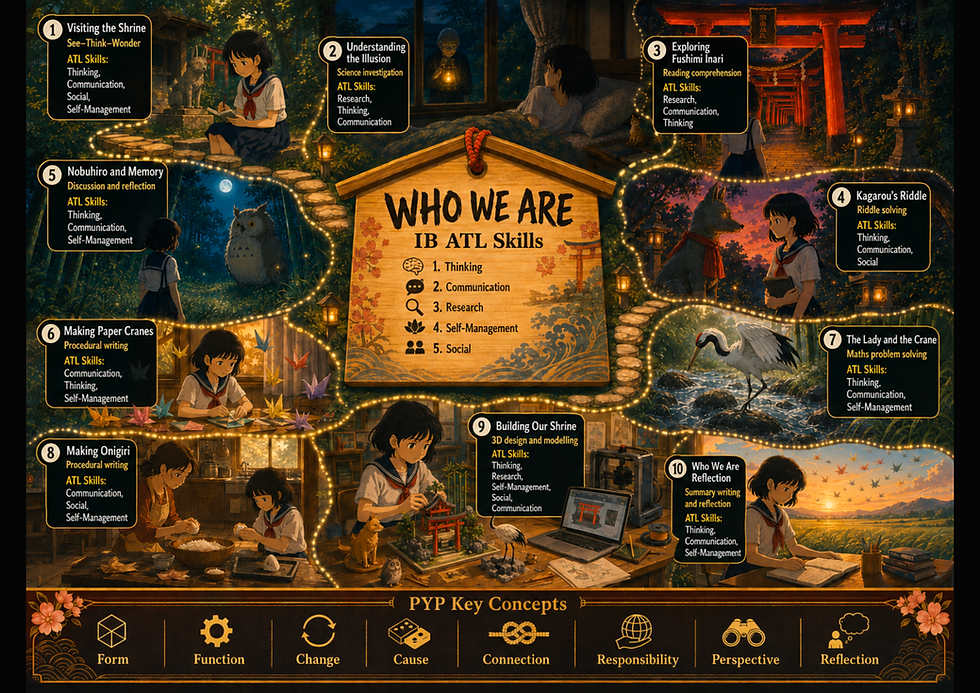
Students investigated how the Pepper’s Ghost illusion works through light, reflection and transparent surfaces. The activity also opened a conceptual discussion around science and spirituality, encouraging students to compare different explanations for what they see and consider how perspective can shape interpretation.
Students’ research and inquiry culminated in reflection on their own beliefs, values and sources of meaning. They designed a shrine for their own ‘spirit animal’, using symbolism to represent the qualities, connections and ideas that are meaningful to their identity.
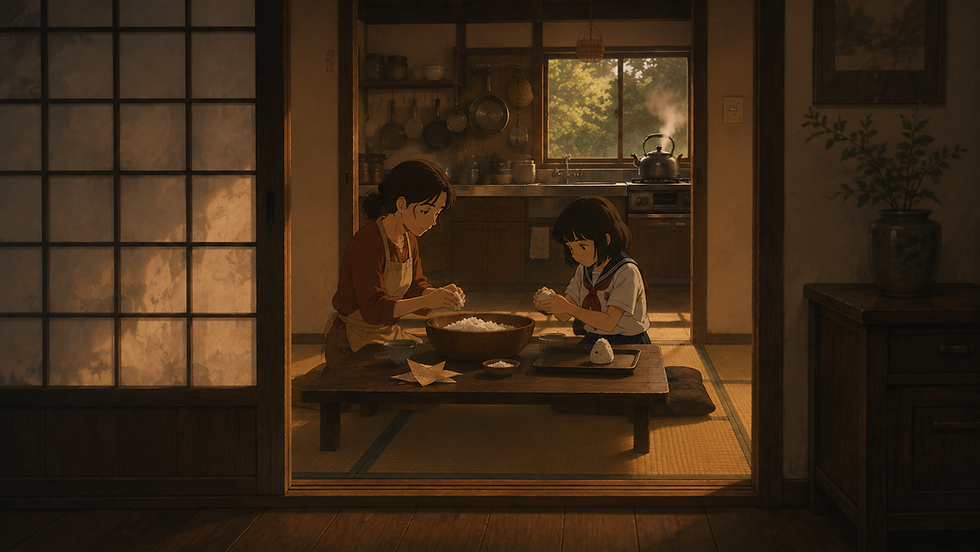


Who We Are follows Aya, a young girl adapting to a new home and school while encountering questions of belief, family, culture and belonging. Moving between everyday life and a mysterious spirit world, the film provides the narrative foundation for the unit’s central idea: our identities are shaped by our beliefs, relationships, cultural experiences and the ways we understand ourselves and others.
Students explored how food can carry personal, family and cultural meaning, using onigiri as a starting point for thinking about identity and belonging. They then applied the experience through procedural writing, sequencing ingredients and steps to create clear recipe instructions.
Students use the Hero’s Journey as a framework for reflection, allowing them to talk about their learning as a journey through different stages, challenges and discoveries. By referring back to key moments, they can explain how their thinking developed, where they encountered difficulties, and what helped them move forward.
